Oppenheimer
5 outta 5
The Barbenheimer social media joke, a double feature viewing of Barbie and Oppenheimer, has merit. Both are making a bunch of bank, both turned out to be pretty great, both have sprawling ensemble casts, and, most surprising, both have thematic similarities about the existential dread of annihilation. Barbie just has more pink. Oppenheimer is a biopic spanning decades about J. Robert Oppenheimer and the development of the atomic bomb. While director Christopher Nolan uses large-scale visuals of the atomic bomb test to give it terrible splendor, this is a very character centric journey about what creating a world changing weapon of mass destruction can do to a person and the planet.
Oppenheimer (Cillian Murphy) is a gifted quantum physicist during World War II who is recruited by US Army General Groves (Matt Damon) to develop an atomic weapon to counteract development by the Nazis. Although Oppenheimer’s previous Communist sympathies may cause political problems, also Oppenheimer is married to the depressed and alcoholic Kitty (Emily Blunt), a woman who used to be a member of the Communist party. Their marriage strains while dealing with a young child as Oppenheimer is having an affair with Jean (Florence Pugh). The development of the atomic bomb, now dubbed the Manhattan Project, recruits multiple scientists, although no one wants to call it a bomb so they call it a “gadget”. Eventually, dropping of two atomic bombs on Japan does end World War II, but the result of this devastating development lingers over Oppenheimer’s life. Years later his security clearance is revoked and the man leading this crusade against Oppenheimer is Lewis Strauss (Robert Downey Jr.). Strauss is convinced the Russians are in nuclear development because Oppenheimer is secretly working with the USSR.
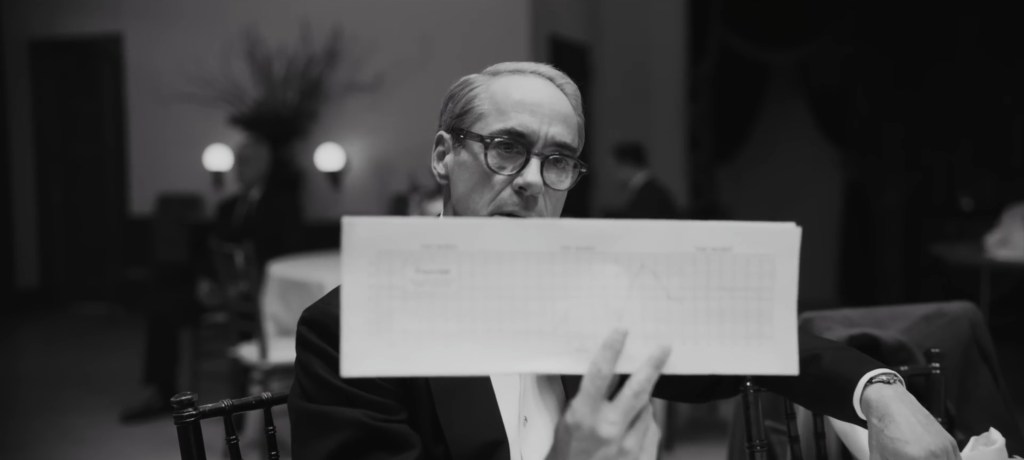
Like a lot of Nolan’s movies, this one jumps around the timeline. It is probably the most chronologically jarring his work has been since Memento. Oppenheimer even has a chunk of it in black and white like Memento as well. When the movie bounces around the different time periods, like an investigation into Oppenheimer’s security clearance that is basically a trial, it becomes the framework for whatever the story is about at that moment. Although the narrative still has a generally straight chronological progression, even with all the flashbacks and flashforwards; the first hour of the movie is about Oppenheimer’s life, the second hour is about the Trinity Atomic test and the dropping of the bomb, and the third hour is about the investigation into Oppenheimer. It becomes sort of a courtroom drama at the end, but with lots of abstract flourishes as Oppenheimer frets about the nuclear horror he unleashed.
The biggest stuff is the trinity test, with a tense slow build towards literally a bombastic payoff. The visuals of the bomb going off are quite spectacular, and the big boom of the test going off is incredibly epic with the gigantic nuclear explosion and then the shockwave hitting in a crushing aftermath. There are some trippy abstract visuals later while Oppenheimer is making a speech celebrating the successful test but through his mind’s eye it becomes menacing with lots of rumbling of nuclear bombs and Oppenheimer seeing visuals of people being blasted apart, all while his audience is cheering what he’s saying. Another effective moment is when Oppenheimer goes to see President Truman (Gary Oldman) after the detonation of the bombs over Japan and Oppenheimer is visibly distraught. Truman writes him off as a crybaby, saying nobody will remember the guy who made the bomb, only the President that decided to drop it.
There’s a subplot about Oppenheimer and the women in his life, and the scenes with Jean and Robert show how she was emotionally unstable as Pugh’s performance as Jean is emotionally raw. Along with his alcoholic wife, Robert gravitated towards troubled women that were also Communist party members which makes things tense at his job. Downey Jr. as Strauss has a slow reveal from genial man of science to bitter scumbag, making Oppenheimer a fall guy for the Russians developing a nuclear bomb. Strauss is such a narcissist he is convinced that a conversation that Oppenheimer had with Albert Einstein (Tom Conti) was about him. Although the eventual reveal about what the two nuclear geniuses were talking about is shattering. Damon as the US Army General has some very effective moments, some bits he comes off as comic relief to all the fussy scientists, and other times are chilling like when he reveals the US’s determination to set off two bombs above Japan. Murphy as Oppenheimer shows a scientist who was caught up creating something that has never been done but he didn’t reckon with the human cost until it was too late. He goes from someone determined for scientific advancement to someone emotionally broken.
There’s a running theme in Oppenheimer that setting off the nuclear bomb could have potentially ignited the atmosphere in a worldwide apocalypse, but it was unlikely as Oppenheimer called the chances “basically zero”. The point of Oppenheimer is that even though the world didn’t catch on fire, a potential nuclear hellfire could be unleashed at any moment. The nuclear bomb didn’t end war, as some optimists had convinced themselves. What the nuclear bomb did was make any war possibly world ending. And that’s scarier than anything imaginable.
 BigAl Reviews
Leave a reply to Blog: Oscars Catch-Up – BigAl Reviews Cancel reply