
Joker: Folie à Deux
3 outta 5
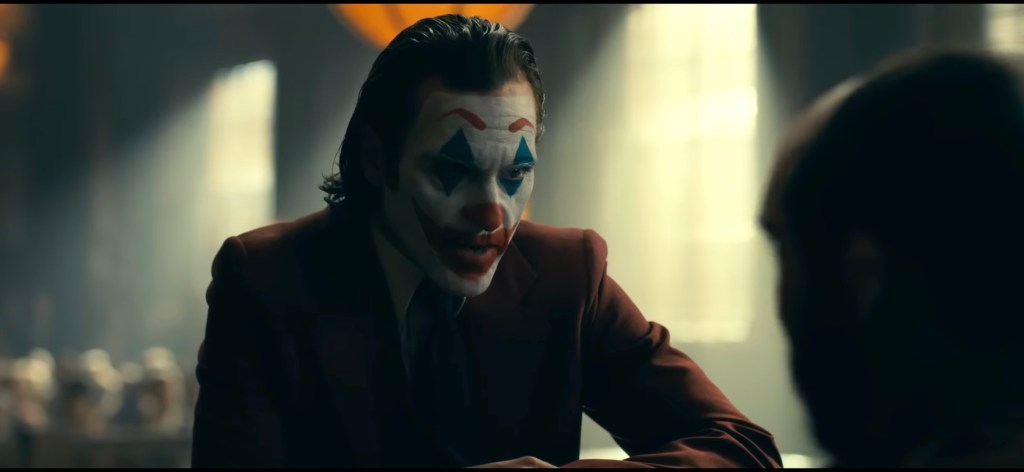
Joker: Folie à Deux is an even stranger sequel to an already strange film. While the first film is heavily influenced by the classic work of Martin Scorsese, this goes more in an unexpected direction. It is sort of a musical, but not really because a lot is mumble singing and none of the songs are original. Also, it weirdly feels a lot like the finale of Seinfeld by having it set in a courtroom with flashbacks and cameos from the previous characters who point out how horrible the main character treated them. The cinematography is quite good and there are some intense moments here and it really takes some big swings at unexpected developments. This works if one just wants a weird take on an iconic DC villain. Although Joker Sings isn’t a twist anyone wanted, and the musical numbers stumble a lot, but at least it attempts something different.
Arthur Fleck (Joaquin Phoenix) is an inmate at Arkham Asylum after he went on a murderous rampage as the Joker. While dealing with a nasty guard, Jackie (Brendan Gleeson), Arthur awaits his trial with his lawyer, Maryanne (Catherine Keener). Also, while in the Asylum, Arthur enters a musical rehabilitation program and meets a patient, Lee (Lady Gaga) who is enamoured of Arthur’s crime spree as the Joker. With Arthur now singing his feelings and Lee encouraging him to embrace his inner Joker, Arthur goes on trial, prosecuted by a crusading DA, Harvey Dent (Harry Lawtey). But while Arthur’s lawyer wants him to admit that he is suffering from a split personality disorder, Arthur slides deep back into his delusions and brings Joker back to the surface, as angry mobs descend Gotham into chaos at the whim of their leader.
The musical direction has uneven results. It can be seen to be influenced by the scene in the first film when Arthur is accosted by three bullies on a subway and one of them starts singing “Send in the Clowns”, and at the end of the first film Arthur sings “That’s Life” in a mumble singing way. In Folie à Deux it is way more mumble singing a few lines that belting out entire tunes, but that is here too. As the movies are from Arthur’s unreliable narrator perspective it often dips in and out of realism, so the random singing does kind of make sense. There are a smattering of scenes where it goes into a bombastic musical number or two. There are two that really stand out, when Lee and Arthur are in a talk show fantasy scene that turns unexpectedly messy, and a bloody anarchy courtroom musical bit. But most of the time it’s just them sadly mumble singing at each other.
Gaga’s version of Lee is quite different from the various incarnations of Harley Quinn that have shown up over the years, she certainly isn’t funny (but neither is Arthur’s Joker anyway). And while Harleen was a psychiatrist who fell in love with Joker, here she is a self-admitted inmate with a degree in psychology. Also, she is manipulating him emotionally, when usually it is the other way around where Harley is helpless to resist Joker. Other versions of Harley usually break up with him, although usually it is because she realizes he is no good for her, while here he isn’t crazy enough for her. Phoenix has an intensity as Arthur when he goes full Joker that is riveting. He does spend most of the first half of the movie kind of turned inward on himself, which isn’t very compelling to watch. Arthur may seem sympathetic at points, and his lawyer, played with genuine feeling for the guy by Keener, does believe that he is ill and needs help. Although Arthur’s actions throughout seem to show a guy who is deep down kind of a nasty, mean, dangerous person who takes joy in taking cheap shots.
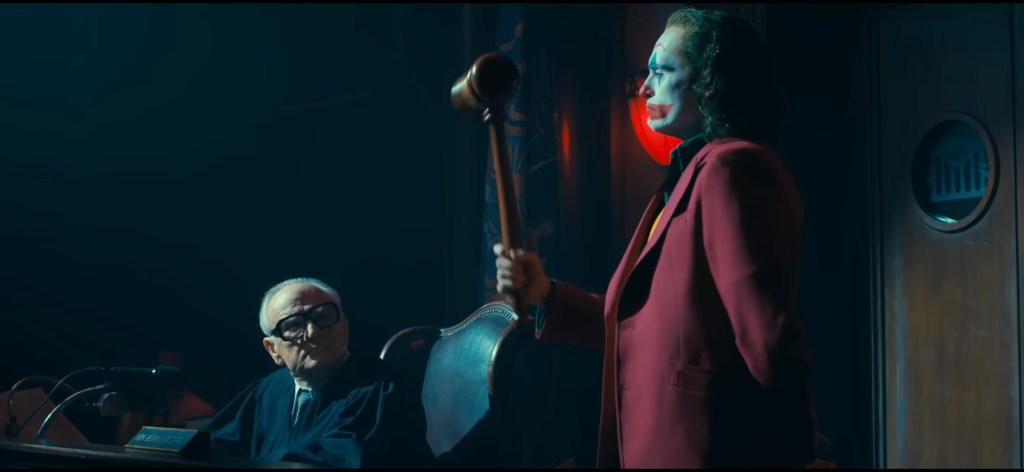
A lot of how the courtroom stuff will hit depends on how well one remembers the events of the previous film. Probably the best bit in the entire movie is when Arthur as Joker confronts his former co-worker, Gary (Leigh Gill). Arthur thought of Gary as his only friend, and even though Joker mockingly mimics Gary’s accent, he does tell Gary that he genuinely does like him. But Gary, in a fantastic performance by Gill, admits that he has felt afraid ever since Arthur killed someone in front of him, and he doesn’t know why Arthur did that to him. It rattles Arthur, something that doesn’t seem possible in his Joker persona, and he changes after that. Well, that changes him and also a trying too hard to be grim scene with the prison guards that is just distasteful.
Joker: Folie à Deux is a movie that takes some big swings, and results in a few big misses, but at least it is a unique take on the character of Joker. And it also confirms that, at least in this world, Gotham is in the State of New York! The final scene of the film is shocking, and probably would tick off a lot of audiences for its abruptness, but it does make twisted sense and asks if Arthur ever really was the “real” Joker. This is an uneven, and sometimes taxing film, but it is wild to watch.


 BigAl Reviews
Leave a reply to Blog: 97th Oscars Catch-Up – BigAl Reviews Cancel reply