The Hobbit: The Battle of the Five Armies (’14 review)
4 outta 5
Now that it’s done the decision to split one novel, The Hobbit, into three movies was an interesting choice but never reached the heights of the Lord of the Rings trilogy. The Hobbit makes for a somewhat requisite but entertaining prequel as the finale The Battle of the Five Armies folds elegantly into the beginning of Fellowship of the Ring (and kind of makes you want to watch Lord of the Rings immediately afterwards, as prequels do). It’ll fit nicely alongside any Rings box set. This particular movie is a very energetic finale, if a bit slight, but will certainly appeal to fans and offers up giant set-pieces, fantastic visuals, and emotional moments.
Desolation of Smaug ended on a spectacularly dramatic cliff-hanger as the dragon Smaug (Benedict Cumberbatch) descended upon Laketown and the opening of Battle continues from that. Bard the Bowman (Luke Evans) is the sole defender against Smaug’s fire and the sequence is one of the best in the series featuring much kerfuffle as Bard has to use his own child to steady his arrow. The best part is Smaug antagonizing the puny Bowman as he’s destroying the town and Cumberbatch’s delivery is dripping evil every word.
Smaug was driven out of the Lonely Mountain by Thorin (Richard Armitage), his company of Dwarves and their burglar, the Hobbit of the Shire, Bilbo (Martin Freeman). In the mountain is treasure and Thorin is obsessed with finding the Arkenstone but Bilbo is hiding it from Thorin’s increasing madness. The Arkenstone doesn’t have a mystical pull over Bilbo (possibly because he’s already carting around the One Ring which has much more magical mojo but that’s never directly stated) and he wants to prevent the humans and elves from invading the mountain. Meanwhile, Gandalf (Ian McKellen) has been trapped by Sauron and coming to his rescue is Galadriel (Cate Blanchett), Elrond (Hugo Weaving), and Saruman (Christopher Lee).
Once again, one of the best things about the Hobbit movies is Martin Freeman’s Bilbo and frustratingly he’s basically a supporting character. But even with little importance on the narrative, Biblo is the emotional centre. Bilbo as the voice of reason against Thorin’s greed retroactively redeems actions Bilbo does in the Rings series. Where Freeman ends up in his final minutes are actually funny and cathartic but also foreshadows his tragic future.
There are several stylistic differences between Director Peter Jackson’s The Hobbit and Lord of the Rings. Most prominently is that Jackson shot The Hobbit in 3D at 48 frames per-second. The high frame rate sometimes looks totally realistic and draws you in while at other times it kind of looks cheap like a too-clear video image. While each Rings instalment had a similar vibe, there is a shift in tone for each Hobbit flick. Journey is a comedic road-trip adventure, Desolation is a heist movie, and Battle is a war-movie / character psychodrama as Thorin descends into isolation.
Armitage spends a lot of the movie obsessed with treasure, making Thorin’s madness compelling, and there’s a nifty bit between him and Evans as Thorin says that the men can’t have his gold. Series vet McKellen acquits himself greatly as Gandalf the wizard who can be Godlike yet also a wounded human. Him and Freeman share a silent moment after the battle when Gandalf is mucking around with his pipe that is oddly hilarious. Another returning vet is Orlando Bloom as the archer elf Legolas and he has some nifty action scenes with his comrade in arms, Tauriel (Evangeline Lilly).
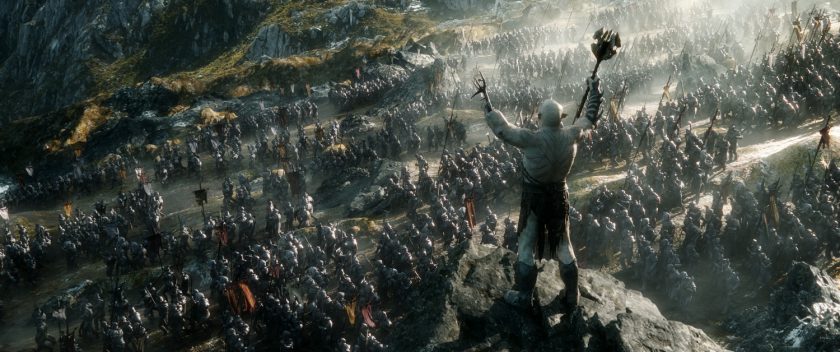
The real star of Battle is the action which practically encompasses almost the entire running time. The scene of Sauron’s dark powers is very trippy as Gandalf’s magic buddies unleash their full might, ending with a nod towards Saruman’s eventual fate. When the five armies converge, it’s gloriously messy with dynamic moments like Thorin and his gang charging into battle or when an elf is riding a War Moose (yes, a War Moose is an actual thing in this movie), spears a handful of Orcs on its antlers and then the elf decapitates them. During the battle the white Orc Azog (Manu Bennett) spends most of it talking trash from a high perch which is kind of awesome. There is also an odd running subplot of Bard and his scheming self-appointed assistant, Alfrid (Ryan Gage), that climaxes in a man-dressed-in-drag gag out of “Monty Python”. Jackson smartly doesn’t draw out the post-climactic ending of Battle as much as Return of the King. Here it breezes relatively quickly with a great button that seamlessly transitions to the Rings trilogy.
Battle of the Five Armies is very good ending even if the entire Hobbit trilogy is only slightly unnecessary in the grand scheme of the Rings narrative. There are a bunch of great moments throughout all three Hobbit films; Gollum and Bilbo’s riddles in the dark in Unexpected Journey, Smaug pontificating on his greatness in Desolation, and the epic battles of Five Armies. For a (probably likely) final journey into Peter Jackson’s version of J.R.R. Tolkien’s Middle-Earth, Battle of the Five Armies is a fondly heartfelt, bombastically loud farewell.
 BigAl Reviews
Leave a reply to The Lord of the Rings: The War of the Rohirrim – BigAl Reviews Cancel reply