The Social Network
(’10 review)
5 outta 5
Director David Fincher’s movies have either been really good or instant masterpieces. From his unjustly underrated Alien 3 to Seven, Fight Club, Benjamin Button and onward. As a happy surprise it turns out that The Social Network makes for a really compelling film. And you don’t even have to be on Facebook to get it. Or is that “Like” with the little thumbs up thingie? Or poke, or tag a wall, or virtual farm, or whatever. Anyway, it’s great movie.
The film follows the origin of one of the world’s most popular websites flashing forward to Facebook co-founder, Mark Zuckerberg (Jessie Eisenberg from Zombieland) in legal battles with former associates. In 2003, college student Mark is contacted by Harvard blue-blood undergrads, identical twins Cameron and Tyler Winklevoss (Armie Hammer, playing both roles), to create a social networking website. Instead, Zuckerberg makes a website called “The Facebook”. It’s a hit around college campuses, and Zuckerberg and his best friend and Facebook co-founder, Eduardo (Andrew Garfield) are soon trying to expand, attracting the attention of a flashy entrepreneur, Shawn (Justin Timberlake), who drives a wedge between them.
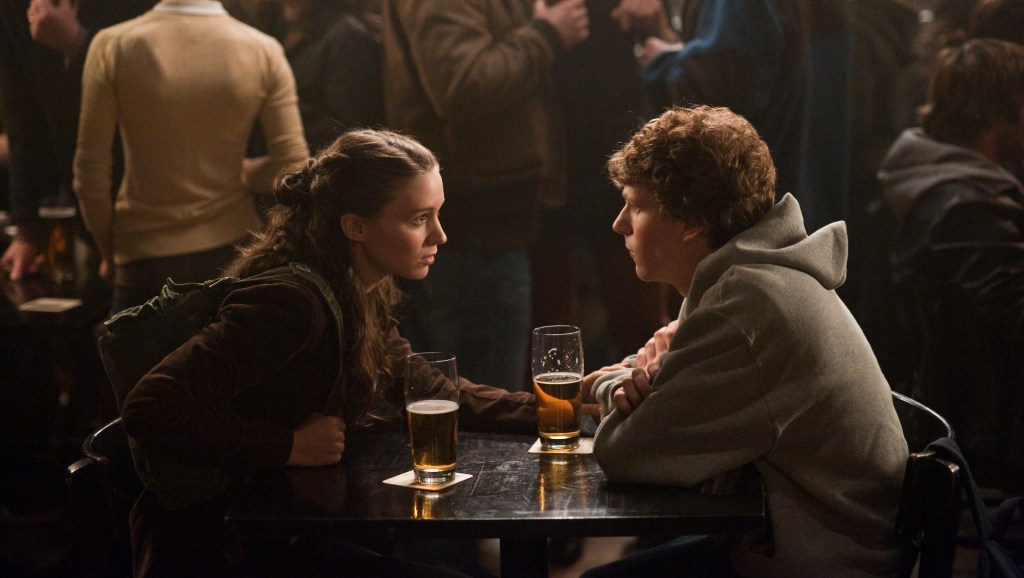
The core thespian work boils down to Eisenberg and future-Spider-Man-actor-to-be Garfield. Zuckerberg has moments of inspiration like when he’s asked by a student if a girl he knows is in a relationship, and he dismisses it saying “people don’t have a sign around their neck,” trails off, then immediately runs adds the “relationship status” to the Facebook template. Eisenberg has always skirted being unlikable but here he’s a condescending jerk from frame one. There are hints of a soul, but never truly shows it, which totally works for the character. The final shot of him mindlessly clicking on Facebook, a solitary boy billionaire, is powerful stuff. Garfield is the heart of the film and gives the audience someone to root for. He’s tragically holding on while his only friend is seduced by promises of success.
Timberlake swoops into the film doing what Timberlake does best, playing it really cocky. As a morally corrupt borderline paranoid egomaniac, Shawn manipulates Zuckerberg into throwing his friend away. Barely in his twenties, Shawn was the co-founder of the iconic music-stealing program Napster, now searching for other business ventures. Timberlake has a great introductory scene as Shawn teases out tidbits of information to a romantic conquest that he was the founder of Napster, much to her astonishment.
At first glance, the Winklevoss’s anger at Zuckerberg for stealing their web site feels like subplot filler, but they add to the film’s theme. The Winklevoss dismissed by various senior august figures is contrasted with Zuckerberg striking out on his own without needing approval of the elderly elite. The performance by Armie Hammer is an astonishing bit of FX trickery with him seamlessly playing each twin. They’re whiny, entitled and you enjoy seeing them get slapped down.
Two huge presences in the film are the music by Trent Reznor and Atticus Ross and the cinematography by Jeff Cronenweth. Nine Inch Nail’s Reznor and his frequent collaborator Ross up the drama with an atmospheric track that features a lot of discordant piano plinking and menacing noise that’s a trademark of NIN’s music. Cronenweth the cinematographer previously worked with Fincher on Fight Club. That movie looked fantastic and so does this. Even something as plain as a dorm room features stark shadows and harsh lighting, but the film really shines visually for a brief scene set at a flashy club with a swirl of bright colours and deep blacks. For a movie set almost entirely in bedrooms, restaurants, and offices, it looks so much cooler than you’d expect.
The script structure by Sorkin is ingenious as it flashes back and forth to Zuckerberg’s legal depositions and his Facebook founding days. It keeps you on your toes, and the dialogue from all the various times seamlessly flows together. A straight-forward chronological recreation could have possibly been dramatic death, but the flipping between the different timelines makes you want to see how these characters ended up so ticked-off at each other.
The Social Network makes an interesting juxtaposition with the leaden Wall Street: Money Never Sleeps. That movie got so bogged down in detail that the character story had no impact. Social Network has a lot of detail, but you see how their decisions affect them emotionally. This may have some well-worn tropes of innocence lost, but it’s so stylishly put together that it feels unlike anything you can see now. It certainly doesn’t make you want to sign up for Facebook. But that was the point.


Leave a comment